Survival of the Sightless: Why Did Cavefish Go Blind?
By Roshni Printer
Adaptation by Losing an Ability
One of the most fascinating aspects of evolution is how population growth is linked to the inheritance of favorable traits. One famous example involves the domestication of animals, increased availability of milk, and the selective advantage to adults who can digest lactose in milk [1]. However, in some cases, evolution also manifests as the loss of traits or functions. An example is the Mexican tetra, Astyanax mexicanus, a freshwater fish species found in caves and streams in Central America.
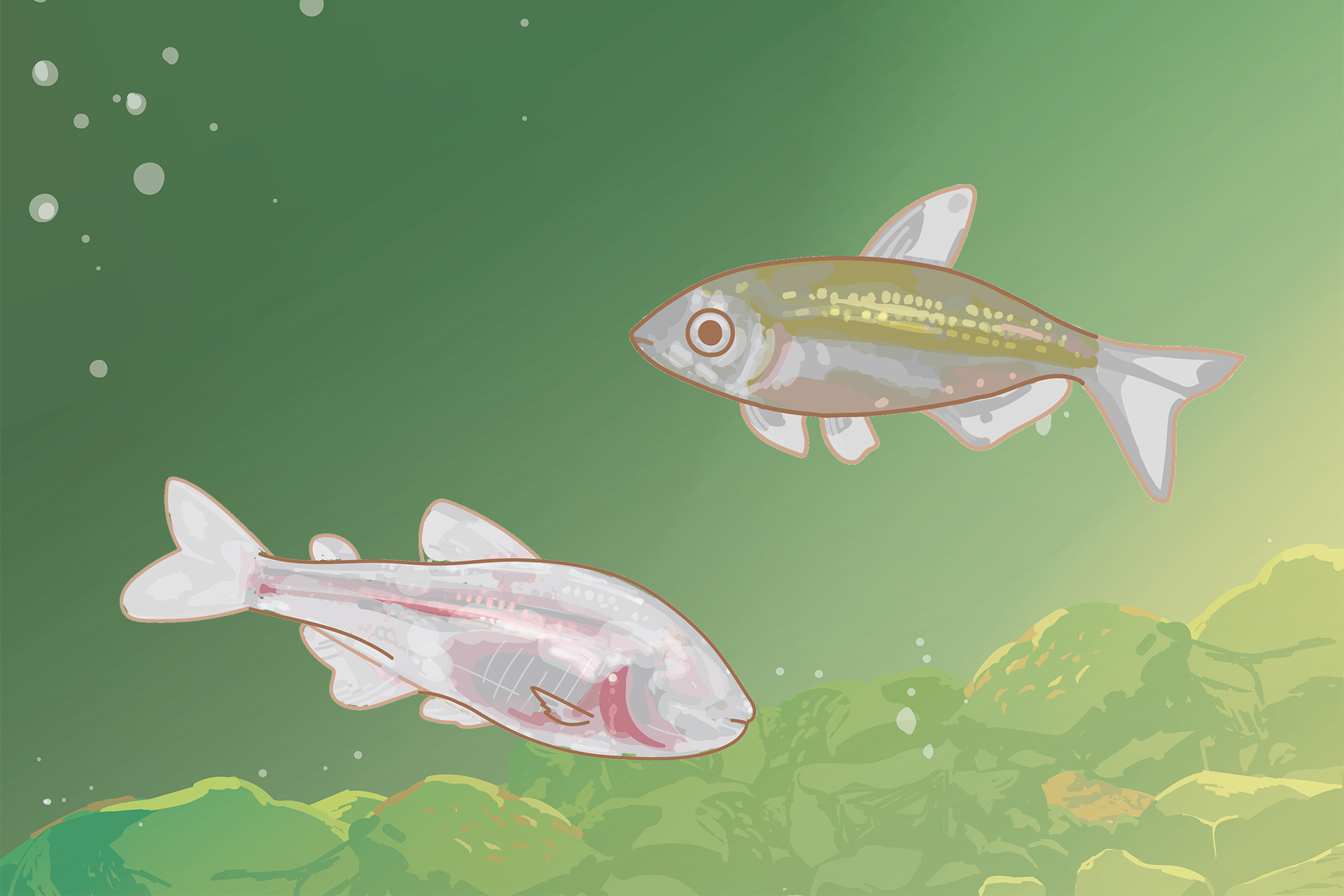
Mexican tetra exists as surface form and cave-dwelling form. Unlike the former which lives near the water surface and have well-developed eyes, the latter lives in caves and have lost their eyes during evolution [2]. Early eye development begins as usual but is disrupted prematurely in the cavefish embryo, and then their eyes degenerate within a few days [2, 3]. The striking difference between the two morphs of the species raises an important question: Why did they lose their sight, which is a fundamental survival function for almost all animals?
Although it seems counterintuitive to lose a function, the answer may lie in energy conservation. In the dark environment of underwater caves where the food supply is scarce, maintaining eyesight poses an unnecessary energy demand to the fish [4]. The metabolic cost of this complex function on the neural tissue to process visual information simply inflicts a heavy burden. Studies found that the cost of vision in young surface-dwelling Mexican tetra can reach up to 15% of their resting energy expenditure, a cost that can be avoided by its cave-dwelling counterpart [4].
How Do Cavefish Lose Their Eyes?
Therefore, one can expect the loss of eyes to be a trait favored by natural selection in dark environments. Then, how can embryonic eye degeneration be achieved at the genetic and molecular levels? Sonic hedgehog (Shh; footnote 1) protein is a morphogen that plays a role in the differentiation of embryonic cells into the brain and spinal cord, eyes, and many other parts of the body [5]. Scientists observed that the Shh protein is expressed in an expanded region along the cavefish embryonic midline [2, 6]. The overexpression of the shh gene was found to inhibit the development of two eye structures, namely lens and optic cup, eventually leading to the degeneration of the eye.
One may speculate that the overexpression is caused by some mutation in the two shh genes of the cavefish, but unfortunately no mutation was found in shh [6]. There is a possibility that the mutations are in other genes which in turn influence the expression of shh [6]. Interestingly, it was reported that the overexpression of shh simultaneously increases the number of taste buds and jaw size in cavefish, enhancing their ability to taste and smell. This is terminologically known as “pleiotropy,” in which a single gene influences multiple seemingly unrelated traits [7]. Considering the loss of eyes as a tradeoff, some scientists even hypothesized that it is the trait of enhanced oral and taste bud development that is favored by natural selection [6].
Nevertheless, regardless of the different guesses regarding the “true meaning” of the trait, a more recent study on the cavefish originated from Pachón cave in Mexico suggested that the loss-of-eyes phenotype could be a result of epigenetic gene silencing, meaning that the phenotype may not be caused by DNA mutations (alternations in DNA sequence) but other mechanisms that turn off the eye development genes [8]. The research team attributed the phenotype to the DNA methylation of those genes, in which methyl groups (–CH3) are added to DNA to inhibit transcription. The expression of the modified genes is therefore stopped, so as their functions to support normal eye development. It is also worth mentioning that many of those inactivated genes are also found in humans and associated with human eye diseases. Thus, further investigation could potentially deepen our understanding of those diseases in human.
Adaptive Strategy Beyond the Loss of Eyes
Cavefish also compensate for the lack of vision through other heightened senses, such as vibration attraction behavior (VAB) [9]. VAB is the ability of some cavefish populations to locate prey by sensing water disturbance. This shift from visual to non-visual methods of survival shows the reallocation of resources that happens because of the environment. Cavefish have also shown evolution in traits such as losses of melanin pigmentation and circadian rhythms, increases in fat stores and body weight, and as mentioned before, the enhanced gustatory and olfactory systems [2, 9].
Different Roads Lead to Rome
While different populations of cavefish develop similar adaptive traits, termed “convergent evolution,” the underlying genetic events or mechanisms are not necessarily the same [10]. The surface fish ancestors which presumably got trapped in different caves and formed different populations have probably developed those traits independently [2, 3, 10]. An example is the albinism in the Molino population and the Pachón population [10]. oca2 is a pigmentation gene required to maintain normal pigmentation of Mexican tetra. In those populations, a deletion can be found in oca2 gene, which causes the production of nonfunctional Oca2 protein. Notably, the deleted sequence within the gene is different in the two populations, meaning that the mutations occurred independently after the ancestors had settled in their caves. Therefore, evolution does not always follow a single path; parallel and convergent evolution of the same species can take place. This makes the Astyanax mexicanus an interesting model to study evolution by allowing researchers to understand how geographically separated populations evolved independently to adapt to similar environments.
The Lesson Learned
The cavefish is smart – they don’t pay the price for vision when there is nothing to see! By studying them, scientists have gained important insights into development, genetics, evolution and human diseases.
Footnote
- This protein from the hedgehog family was named after the video game character, Sonic the Hedgehog [11], by Robert Riddle and his research advisor Cliff Tabin. It is a vertebrate homolog of hedgehog, a protein originally discovered in the fruit fly, Drosophila. The other vertebrate homologs are named Desert hedgehog and Indian hedgehog. Each hedgehog protein is known to play important roles in the development of specific body parts.
References
[1] Ingram, C. J. E., Mulcare, C. A., Itan, Y., Thomas, M. G., & Swallow, D. M. (2009). Lactose digestion and the evolutionary genetics of lactase persistence. Human Genetics, 124(6), 579–591. https://doi.org/10.1007/s00439-008-0593-6
[2] Jeffery, W. R. (2020). Astyanax surface and cave fish morphs. EvoDevo, 11, 14. https://doi.org/10.1186/s13227-020-00159-6
[3] Huynh, L., & Bock, R. (2018, May 29). NIH researchers identify how eye loss occurs in blind cavefish. National Institutes of Health. https://www.nih.gov/news-events/news-releases/nih-researchers-identify-how-eye-loss-occurs-blind-cavefish
[4] Moran, D., Softley, R., & Warrant, E. J. (2015). The energetic cost of vision and the evolution of eyeless Mexican cavefish. Science Advances, 1(8), e1500363. https://doi.org/10.1126/sciadv.1500363
[5] National Library of Medicine. (2010, September 1). SHH gene: Sonic hedgehog signaling molecule. MedlinePlus. https://medlineplus.gov/genetics/gene/shh/
[6] Jeffery, W. R. (2010). Pleiotropy and eye degeneration in cavefish. Heredity, 105(5), 495–496. https://doi.org/10.1038/hdy.2010.7
[7] Stearns, F. W. (2010). One Hundred Years of Pleiotropy: A Retrospective. Genetics, 186(3), 767–773. https://doi.org/10.1534/genetics.110.122549
[8] Gore, A. V., Tomins, K. A., Iben, J., Ma, L., Castranova, D., Davis, A. E., Parkhurst, A., Jeffery, W. R., & Weinstein, B. M. (2018). An epigenetic mechanism for cavefish eye degeneration. Nature Ecology & Evolution, 2(7), 1155–1160. https://doi.org/10.1038/s41559-018-0569-4
[9] Kowalko, J. (2020). Utilizing the blind cavefish Astyanax mexicanus to understand the genetic basis of behavioral evolution. Journal of Experimental Biology, 223(Suppl 1), jeb208835. https://doi.org/10.1242/jeb.208835
[10] Protas, M. E., Hersey, C., Kochanek, D., Zhou, Y., Wilkens, H., Jeffery, W. R., Zon, L. I., Borowsky, R., & Tabin, C. J. (2006). Genetic analysis of cavefish reveals molecular convergence in the evolution of albinism. Nature genetics, 38(1), 107–111. https://doi.org/10.1038/ng1700
[11] Cliff Tabin. (2008). Nature Reviews Genetics, 9(6), 420. https://doi.org/10.1038/nrg2381