Decoding the Aerodynamics of Incredible Shots Across the Sport Arena
By Sam Fan 樊潤璋
Moments Made for Slow Motion
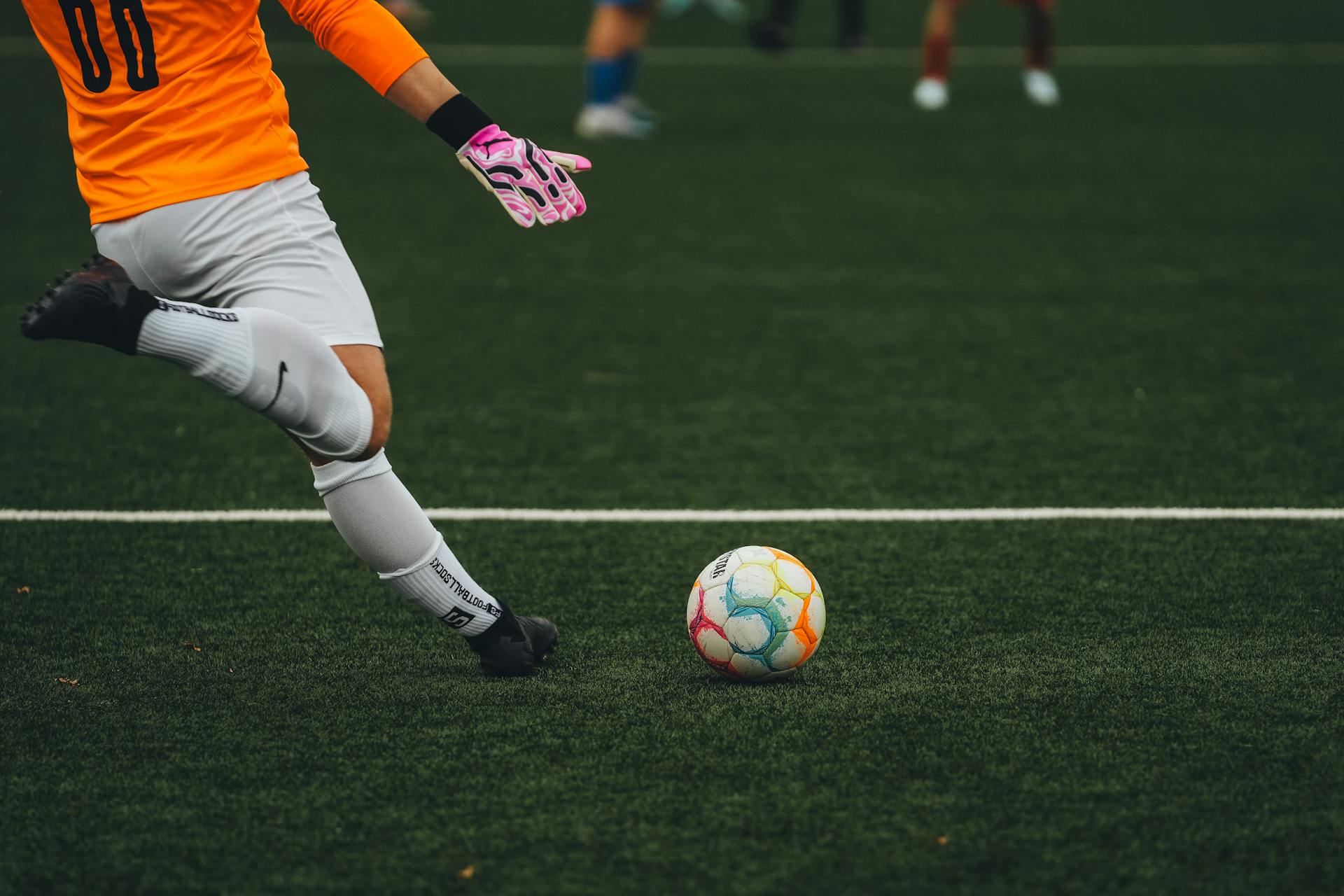
You must have seen the highlights: Lionel Messi’s free kick curls around a wall of players as if it were being pulled by an invisible hand, bending perfectly into the top corner of the goal. This is the classic “banana kick.” On the volleyball court, Japanese star Yuji Nishida strikes the ball with spin, causing it to bend sharply just before it reaches the receiver, often forcing a mistake in receive, or even scoring a clean ace. Then there are float serves, shots hit with almost no spin that can suddenly drift sideways in midair.
These tricks may seem very different, happening on different courts and fields, but they are all driven by the interaction between a moving ball and the air surrounding it. Whether a ball spins rapidly or barely at all, subtle changes in airflow can dramatically alter its path. This raises an interesting question: What exactly determines how a ball flies? Of course, the player's technique matters: the power of the kick, the angle of contact, and the amount of spin they apply. How about a ball that is perfectly round and completely smooth? Would it be easier to control and more predictable in flight? Uncovering what lies behind these factors reveals how players can control a ball’s motion by changing the way it interacts with the air.
The Magnus Effect
Balls used in sports are rarely a perfect sphere but often with stitching and surface texture. When a ball is spinning, the friction drags the surrounding air along with the rotation, setting the nearby airflow into motion [1–3].
As shown in Figure 1, on the side of the ball where the surface motion works against the airflow, the air struggles to stay attached and breaks away from the surface much earlier (point A). On the opposite side where the surface rotation is aligned with the airflow, the rotation helps the air remain attached for longer and follows more of the ball’s curved surface before it separates (point B). As a result, the airflow behaves differently on the two sides of the ball; the air on the side where the rotation is opposite to the direction of air motion is deflected more strongly than the other side [2, 4].
By Newton’s third law, when the ball deflects the surrounding air more strongly to one side, say to the left, the air molecules push back with an equal and opposite force (Figure 1). This reaction force acts sideways on the ball causing the ball to curve in flight, an effect known as the Magnus effect. The direction of the curve depends on the direction of spin [2, 3, 5].

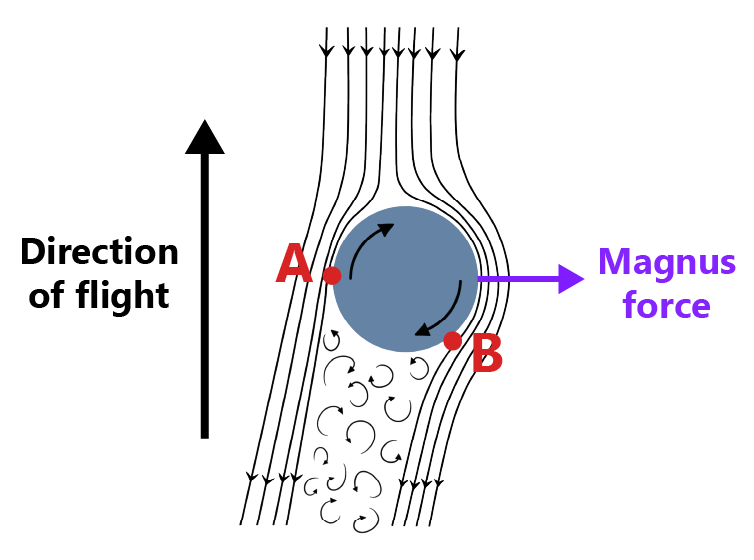
Figure 1 A diagram showing the airflow surrounding a ball in motion. Air separates from the ball surface at points A and B. On the side of the ball where the motion works against the airflow, the air struggles to stay attached, whereas the air remain attached for longer on the opposite side.
The Knuckleball Effect
How about Cristiano Ronaldo’s signature knuckleball free kick with almost no spin? When such a ball moves through the air, it pulls some of the surrounding air along with it, but this air cannot always follow the ball’s curvature all the way around. Eventually, it will separate from the surface. Without spin to stabilize this separation, the ball no longer experiences the smooth sideways force seen in the spinning case. But that doesn’t mean it will fly straight; its motion actually becomes harder to predict [6, 7].
Ideally, if the airflow separated evenly on all sides, the wake would remain balanced and the ball would fly straight. In reality, without spinning to stabilize the flow, even small disturbances due to the seams on the ball [3], tiny changes in air speed, or turbulence in the surrounding air can cause the airflow to break away earlier on one side than the other randomly, with the separation point shifting from side to side during flight. When this happens, the force acting on the ball also becomes unbalanced and constantly changing [6–8]. This may cause the ball to wobble, dip, or suddenly veer off course while it is in the air, making it difficult for opponents to judge where it will go next. This is commonly seen in volleyball float serves that suddenly drop just before the bottom line and football knuckle shots that seem to hang in the air before dipping unexpectedly.
In the 2010 FIFA World Cup, the extra smooth match ball called “Jabulani” drew widespread criticism for its erratic flight. When a ball's surface texture is too smooth, it cannot “grip” or effectively drag the surrounding air by friction, making the airflow harder to maintain attached to its surface. As a result, the airflow tends to separate more easily and unpredictably, pushing the aerodynamics toward the knuckleball effect rather than a stable Magnus effect.
The Aerodynamicist's Toolkit: Applications Across Industries
To understand aerodynamics of "Jabulani,” scientists conducted wind tunnel experiments, mounting the ball on a support rod and blowing air past it at controlled speeds to measure drag and lateral forces directly. The measured data were then applied to computer simulations, to predict and analyze its flight paths by solving complex equations of fluid motion [6]. These methods are not limited to sports but also applied to investigate aircraft wings to improve lift and control, vehicles to reduce air resistance, and buildings to understand how strong winds act on tall structures. In the 2026 World Cup, it will be interesting to see what new surprises the next generation of match balls may bring.
References
[1] Anderson, J. D., & Cadou, C. P. (2023). Fundamentals of Aerodynamics (7th ed.). McGraw-Hill Education.
[2] Mehta, R. D. (1985). Aerodynamics of Sports Balls. Annual Review of Fluid Mechanics, 17(1), 151-189. https://doi.org/10.1146/annurev.fl.17.010185.001055
[3] Carré, M. J., Goodwill, S. R., & Haake, S. J. (2005). Understanding the Effect of Seams on the Aerodynamics of an Association Football. Proceedings of the Institution of Mechanical Engineers, Part C: Journal of Mechanical Engineering Science, 219(7), 657–666. https://doi.org/10.1243/095440605x31463
[4] Kray, T., Franke, J., & Frank, W. (2014). Magnus effect on a rotating soccer ball at high Reynolds numbers. Journal of Wind Engineering and Industrial Aerodynamics, 124, 46–53. https://doi.org/10.1016/j.jweia.2013.10.010
[5] Goff, J. E. (2010). Gold Medal Physics: The Science of Sports. Johns Hopkins University Press.
[6] Goff, J. E., Asai, T., & Hong, S. (2014). A comparison of Jabulani and Brazuca non-spin aerodynamics. Proceedings of the Institution of Mechanical Engineers, Part P: Journal of Sports Engineering and Technology, 228(3), 188–194. https://doi.org/10.1177/1754337114526173
[7] Watts, R. G., & Sawyer, E. (1975). Aerodynamics of a knuckleball. American Journal of Physics, 43(11), 960–963. https://doi.org/10.1119/1.10020
[8] Asai, T., Seo, K., Kobayashi, O., & Sakashita, R. (2007). Fundamental aerodynamics of the soccer ball. Sports Engineering, 10(2), 101–109. https://doi.org/10.1007/bf02844207