Extraterrestrials
Prof. Alex Law (Adjunct Professor in the Division of Life Science, HKUST)
“Sometimes I think we’re alone in the universe, and sometimes I think we’re not. In either case the idea is quite staggering.”
— Arthur C Clarke (Note 1)
When he said we, it was not quite clear if he meant any lifeforms, or he was only referring to a species with intelligence.
We like to think that we humans are “intelligent”. There had been evidence that some animals could display certain levels of “human intelligence”. However, when we consider “intelligence” in the cosmic scale, we have to take into account that our Earth is one of the eight planets of our star, the Sun, which is one of the 200-400 billion stars in our galaxy, which, in turn, is one out of the 1–2 trillion galaxies in the “observable” universe. Using our perception as a yardstick of intelligence is neither adequate nor appropriate. We need to look for some other measurable definition. The ability to communicate through space was the choice. Thus, programs were set up in the attempt to detect any “meaningful” signal from “anywhere out there”.
Information transmitted without physical contact was first demonstrated by Michael Faraday in the form of electromagnetic induction in 1831. In the simplest description, the movement of a magnet through an electrical conducting coil would generate a current in the coil, which can be detected. This laid the foundation for the subsequent development of wireless telegraphy using radio waves by Guglielmo Marconi and Karl Ferdinand Braun (Nobel Prize in Physics in 1909). The question was turned around when people pondered if there is “intelligence” out there, would they be interested to communicate with us through such “wireless” technology? Attempts to “Search for Extra-Terrestrial Intelligence (SETI)” were conducted by many trying to detect signals at various points of the electromagnetic spectrum. It was not until the Ohio State University SETI Program that became the first continuous systematic setup to scan for radio signals of cosmological origin. The construction of Ohio State University Radio Telescope, called the “Big Ear”, started in 1956 and was completed in 1961. Between the years 1963 and 1971, the Ohio Sky Survey would provide a catalogue of extragalactic radio sources. From 1973, the “Big Ear”, was dedicated to the SETI program until 1995.
Unlike the survey for radio sources, in which each source would be observed at a constant, or regular cyclic, intensity, SETI would look for aperiodic signals that could vary with time. In 1977, Jerry Ehman, on examination of the recordings collected from the “Big Ear” found a signal on 15 August at 0216 UTC (or Coordinated Universal Time, the new standard in succession to the Greenwich Mean Time). The signal lasted for 72 seconds, displaying a Gaussian shape over time. Ehman wrote down “WOW” on the print-out and the signal had since been popularly referred to as the WOW signal. Only the print-out survived, as the storage device at that time had only a capacity of 1 Mb, and it was the standard operation procedure to have it wiped clean for reusing purposes. The signal was not seen again despite enormous efforts to “chase” the signal from many telescopes around the world. In addition, there was no satisfactory explanation that it could be generated from an earthly source.
Whereas there were uncertainties on the origin of the WOW signal, we also attempted the reverse, to communicate with the “extraterrestrial intelligence” by various means. The first of these were the two plaques (Figure 1) on the spacecrafts Pioneer 10 in 1972 and Pioneer 11 in 1973. The plaques were made of gold anodized aluminium, measuring 9 inches by 6 inches with a thickness of 0.05 inches, weighing about 4.2 ounces (or approximately 226.6 mm x 152.4 mm x 1.27 mm, and 120 gm) (Note 2).
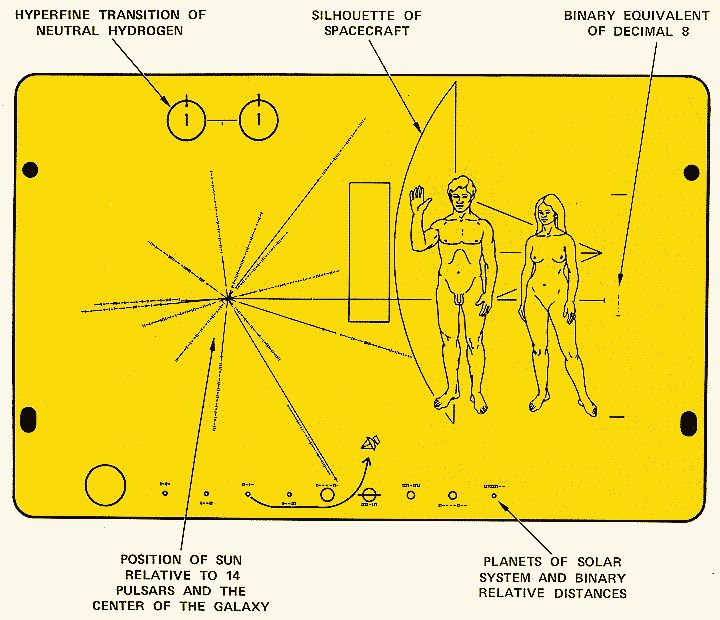
Figure 1 The plaques on Pioneer 10 and Pioneer 11.
Etchings were carefully designed to provide a wealth of information about our location in the galaxy, our solar system, our very basic knowledge of fundamental science and our species Homo sapiens. It probably has the fundamental flaws in assuming any “advanced” civilization would understand our symbols. In any case, they are out there. Pioneer 10 is about 131.6 AU (Note 3) from us in 2022, going away at a speed of 400 million km per year, or translating to 12.6 km/sec (speed of light = 300,000 km/sec). It is less than one light-day away, and it will take about 75,000 years to reach the closest star outside our solar system, Proxima Centauri, 4.2 light-years away.
The plaque was probably fun for the scientists to argue among themselves about the design, rather than having any realistic chance of being picked up by any extraterrestrial intelligence, who may or may not have the same “wavelength” as our human intelligence. If we make the assumption that any intelligence could only be developed on planets, the plaques would be in the vicinity of a planetary system in 75,000 years. By that time, there is the real possibility that our “intelligence” could become extinct, if not the entire Homo sapiens species.
The more serious attempt was the Arecibo message in 1974. The Arecibo Ionosphere Observatory was a USA owned (under the National Science Foundation, NSF) facility in Puerto Rico. The main instrument was the Arecibo Telescope with a dish of 1,000 inches (or about 305 m) in diameter (see Notes 2 and 4). The construction started in the mid-1950s and was completed in 1963. It had multiple purposes for research in radio astronomy and atmospheric science, detection of near-earth objects including incoming meteors and missiles, and in the search for extraterrestrial intelligence (SETI).
The most notable contribution of the Arecibo Telescope to SETI was the Arecibo Broadcast on 16 November 1974. The message (Figure 2) consisted of 1679 binary digits transmitted at about 10 bits per second with a power of 450 kW aimed at the M13 cluster (Note 5). M13 is a star cluster of over 100,000 stars within our galaxy consisting of about 300,000 stars. It is 23,000 light years away and it is out of the galactic plane. The rationale is that the path between Earth and the cluster is relatively star-free, and the probability of hitting an “intelligent civilization” in the densely-packed star system would be “higher”. 1679 is a semiprime in that it is the product of two prime numbers, in this case 73 x 23. When displayed in 23 columns by 73 rows, it would display an image that was “meaningful” to us human, but not when it was in 79 columns by 23 rows. The image was at very low resolution, it would be ridiculous to think any extraterrestrial could make any sense out of it. Indeed, without the guidance from the designers of the message, it is still difficult, if not impossible, for most of us to follow.
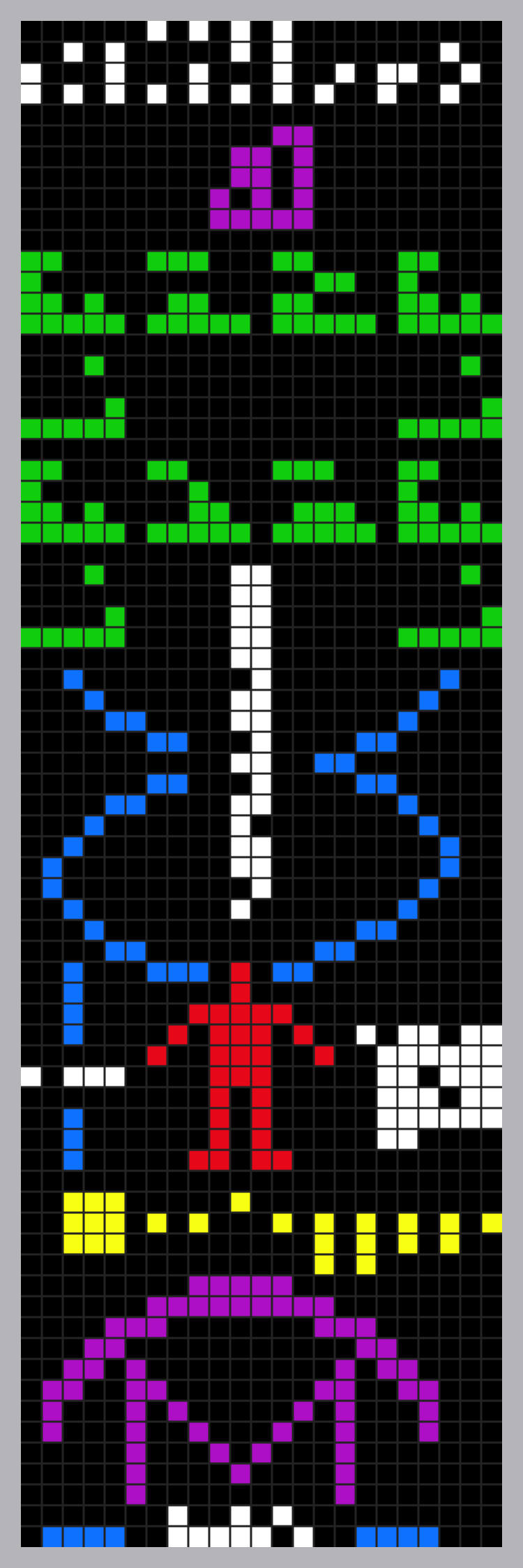
Figure 2 The Arecibo message: Explanation of the image can be found in https://en.wikipedia.org/wiki/Arecibo_message
One problem with the WOW message was that there was no “repeat message” to confirm it. The irony is that with the Arecibo broadcast, we only sent it once. Assuming that there are intelligent recipients at the destination, they would be equally frustrated having to wait and search for confirming messages.
As we understand today, information cannot be transmitted faster than the speed of light at 300,000 km/sec. Below is a list of the time it takes for a message to get to the respective destinations.
| Moon | ~ 4 x 10⁵ km | 1.3 sec |
| Sun | ~ 1.5 x 10⁸ km | 8 min 19 sec |
| Mars | ~ 0.8 x 10⁸ km (closest) ~ 3.8 x 10⁸ km (farthest) | 4 min 30 sec (closest) 20 min 45 sec (farthest) |
| Proxima Centauri (closest star) | ~ 4.2 light years | |
| Alpha Centauri A (closest G-type star) (Binary with Alpha Centauri B) (Note 6) | ~ 4.4 light years | |
| Tau Ceti (closest solitary G-type star) (Note 7) | ~ 12 light years | |
| M13 | ~ 23,000 light years | |
| Galactic Centre | ~ 27,000 light years | |
| Andromeda (closest galaxy) | ~ 2.5 million light years |
The times are for a one-way transmission. If we wish to “communicate”, and assuming that the recipient intelligence would understand the message, have the wish to communicate, and the technology to send a reply, it would take twice the time for us to receive it. For Mars, it would take, on average, 20 minutes for a return message. It is possible but quite inconvenient. (Next time when you talk on the phone, try to stop for one second before replying. I am sure you would find the conversation quite disconcerting.) Communication with the Tau Ceti systems would take over 24 years for a return message. There are planets and several of them may be considered “habitable”, but there is no evidence of “lifeforms” of any kind. We can forget about the more distant star systems just because of communication difficulties.
Perhaps Arthur C Clarke was right to find the idea on the existence of extraterrestrials staggering; even if we are not alone, the universe's strict speed limit ensures that we must endure the silence. Ultimately, whether the cosmos is teeming with life or entirely empty, the sheer vastness of space leaves us practically alone to forge our own destiny.
Acknowledgement
I am indebted to Kenneth Young, Professor Emeritus of the Chinese University of Hong Kong.
Notes
1. Arthur C Clarke (1917–2008): a prolific science fiction writer. His most famous work was the book and film 2001: A Space Odyssey.
2. The plaques were made in the USA, hence the dimensions were in inches, and the weight in ounces.
3. AU stands for Astronomical Unit, which is the average distance between the Earth and the Sun, approximately 150 million km.
4. The Arecibo Telescope was decommissioned in 2020 after cable failures through “controlled demolition”.
5. Location of the M13 star cluster: http://www.galaxies3d.org/starcl-messier-objects-mw.htm
6. The Alpha Centauri is in fact a triple star system, with 2 relatively massive Alpha Centauri A (Rigil Kentaurus), Alpha Centauri B (Toliman), and a much smaller Proxima Centauri. They are gravitationally bound. Alpha Centauri A is a G-type star, and Alpha Centauri B a K-type star, whereas Proxima Centauri a type-M star, or a red dwarf.
7. G type stars are also known as “yellow dwarfs” of which our Sun is one.