Why Is the Chicken Egg Shaped the Way It Is?
By Ian Cheng 鄭朗健
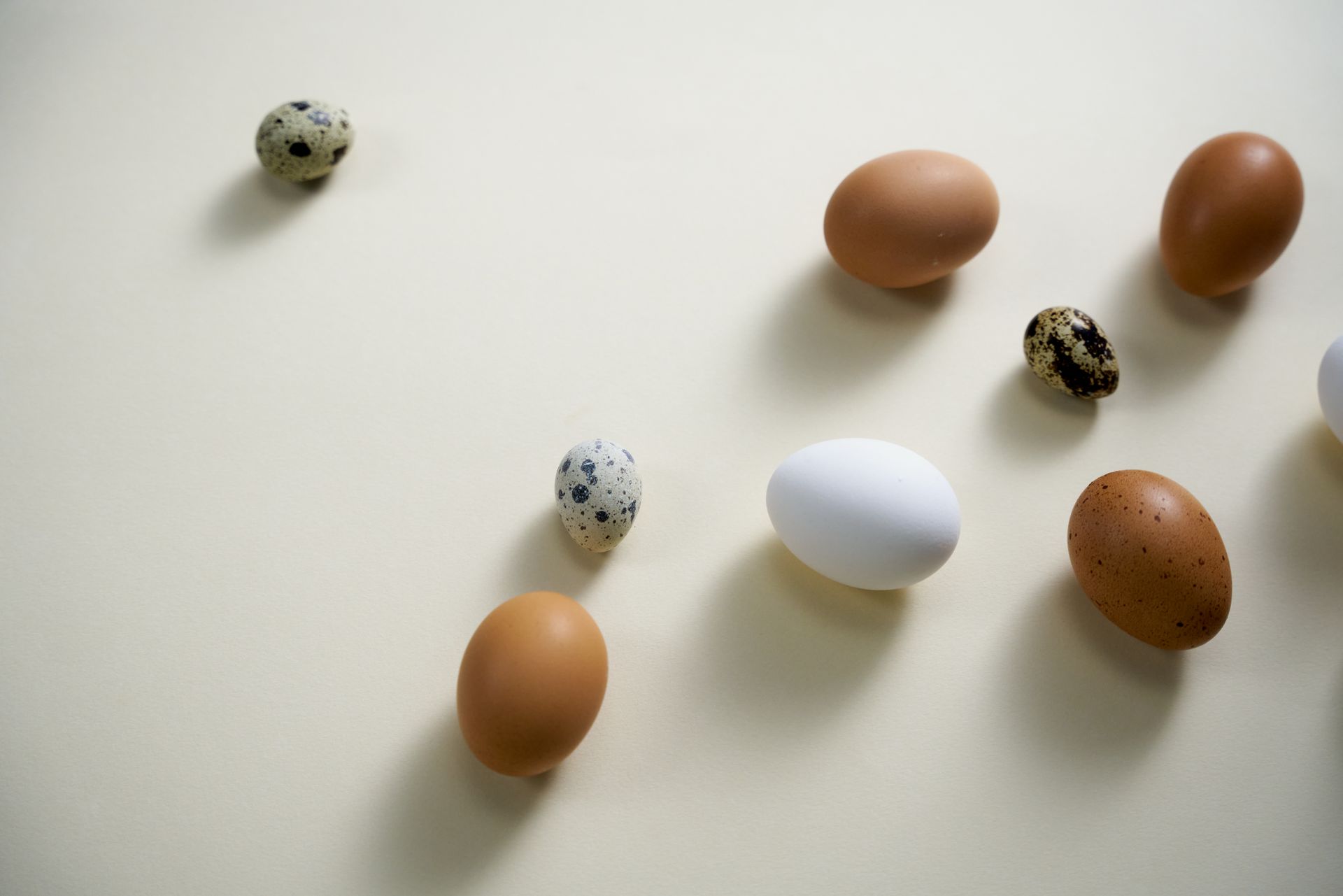
In the refrigerated section of almost any supermarket, rows of white or brown eggs sit neatly in stacks of cartons, waiting to be picked up by grocery shoppers. Their shape is a familiar asymmetric ellipse, as if they were cast from the same mold. So familiar that one rarely gives it a thought, as if it is synonymous with the word “egg.” But why? Why are eggs shaped the way they are?
How Does the Chicken Egg Form?
To crack open the mystery of egg shape, we must first understand the biology of how chicken eggs form. Unlike the female reproductive organs of humans, a hen (an adult female chicken) consists only of a single ovary and an oviduct. While both female humans and hens begin development with two sets of ovaries and oviducts, only the left set matures in hens. The other set regresses before the hen hatches [1].
The ovary is where oocytes (the immature egg cells) mature and are released into the oviduct. Remarkably, the mature chicken oocyte – the yolk – is a single cell with a diameter of four to five centimeters [1]. This is about eight orders of magnitude larger than the human egg cell. In other words, if the human egg cell were the size of a tennis ball, the yolk would be roughly the size of a large lecture hall.
As the yolk passes through the oviduct, it slowly rotates, allowing egg white (albumen) to be deposited evenly around it [1]. The section toward the end of the hen's oviduct is called the isthmus. In this section, two layers of shell membranes form outside of the yolk, which serve as the foundation of the eggshell. The membraned egg then enters the shell gland (uterus). Calcite (calcium carbonate) crystals deposit onto the membrane, forming the eggshell [1].
What About the Shape of the Chicken Egg?
Like hen eggs, it is well known that eggs are generally pointed at one end and blunt at the other. Scientists have long speculated on the evolutionary reason behind this shape. One well-known hypothesis is that asymmetric eggs are selected among cliff-nesting birds as they roll in tight circles, which prevents egg loss [2].
In 2017, a large-scale study collected egg data of 1,400 avian species to study the evolutionary reasons behind the shape of the egg. They found that the shape of eggs varies on a spectrum of asymmetry and ellipticity, ranging from spherical, symmetrical eggs on the one end to asymmetrical and elliptical eggs on the other end. Interestingly, when scientists plotted a density map of the 1,400 species, most bird species lay more asymmetric and elliptical eggs than chickens do [2].
With a wide spectrum of egg shapes, what is the biological mechanism behind the shape of an egg?
The Biological Mechanism Behind Egg Shape
Scientists hypothesized that the shape of the egg is largely determined by the shell membrane [2]. Isn't it surprising? At first glance, the hard, thick eggshell seems to be the primary structure that upholds the egg. Yet, when the eggshell is dissolved by vinegar, the shape of the egg remains. If the eggshell were the sole determinant of the egg shape, the egg would collapse upon the removal of the eggshell. So, if the eggshell does not determine the shape, what does? An x-ray radiographic study has shown that a hen egg that has just passed into the shell gland has already taken up a well-defined shape [3].
Based upon these observations, scientists developed a biophysical model able to predict the shape of a membranous egg with two factors: pressure difference across the shell membranes and variations of membrane properties. The pressure difference across membrane may arise from the fluid pressure within the egg sac, the elasticity and muscular contraction of the isthmus wall. Differences in how easily the membrane stretches along the oviduct axis produce ellipticity, while variations in membrane material properties between the two halves of the egg give rise to asymmetry [2].
After the egg obtains its shell membrane, the formation of the eggshell begins in the isthmus just before the egg enters the shell gland. As the process starts, the shell gland secretes calcium carbonate around the egg. Anchored on the shell membrane are small calcite buds which act as a foundation to allow calcium carbonate to attach to [4]. As time passes, the eggshell thickens. After 18 to 20 hours, the eggshell becomes fully hardened, creating a rigid, fixed egg shape thereafter [1].
Evolution of Egg Shape
Now we understand the biological mechanism behind egg shapes, and the fact that most eggs are more asymmetrical and elliptical than chicken eggs. What could be the evolutionary needs that drive this trend?
From the data of the 1,400 avian species, researchers found a strong correlation between better flight ability and asymmetric eggs, elliptical eggs and larger egg sizes relative to body mass. They theorized that strong flight selects for avian species with a slimmer, more streamlined body, which limits the maximum stretchability of the isthmus or the uterus. In turn, the egg takes up a more asymmetrical and/or elliptical shape to maximize the egg volume without increasing its girth [2]. Perhaps this explains why chicken eggs are less asymmetric and less elliptical than those of most other birds. Interestingly, the researchers did not discover a correlation between cliff-nesting birds and asymmetrical eggs [2].
Conclusion
Every day, countless eggs are cracked open in kitchens around the world. The translucent egg white and the yellow yolk fall out of the shell into hot pans, following with sizzling sound, white smoke and the smell of oil. The humble shell gets tossed into the bin in the corner of the kitchen. To the average person, the shell is just a piece of packaging for the egg, something to be discarded without a second thought. Yet, as we have seen, its shape is the result of a delicate interplay between physical forces, biological structures and evolutionary pressures, refined over countless generations. Perhaps this raises a broader question: How many other everyday objects around us carry similarly hidden magnificent science, waiting to be “cracked open”?
References
[1] Khamas, W., & Rutllant, J. (Eds.). (2024). Reproductive System. In Anatomy and Histology of the Domestic Chicken (pp. 93–108). John Wiley & Sons.
[2] Stoddard, M. C., Yong, E. H., Akkaynak, D., Sheard, C., Tobias, J. A., & Mahadevan, L. (2017). Avian egg shape: Form, function, and evolution. Science, 356(6344), 1249–1254. https://doi.org/10.1126/science.aaj1945
[3] Bradfield, J. R. G. (1951). Radiographic Studies on the Formation of the Hen's Egg Shell. The Journal of Experimental Biology, 28(2), 125–140. https://doi.org/10.1242/jeb.28.2.125
[4] Creger, C. R., Phillips, H., & Scott, J. T. (1976). Formation of an Eggshell. Poultry Science, 55(5), 1717–1723. [Cordyceps flower: Neither insect, nor grass, nor flower]. School of Chinese Medicine, the Chinese University of Hong Kong. https://www.scm.cuhk.edu.hk/en-gb/news-and-literature/articles/articles-hkej-list/2212-2021-09-17/