Cordyceps Flowers: A Parasitic Horror Story
By Roshni Printer
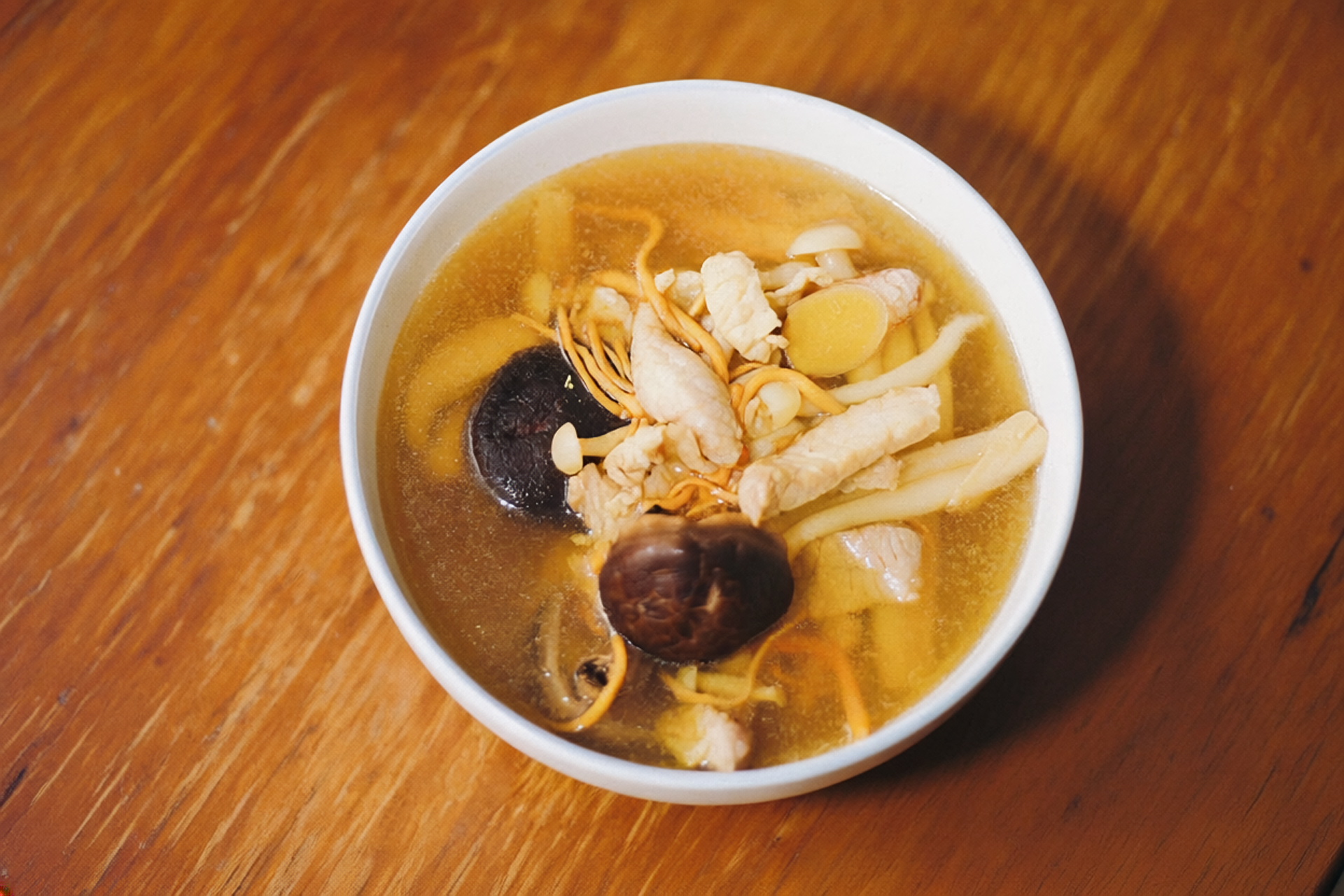
Have you ever wondered what it would feel like to be so hungry because there are parasites in your body draining all your nutrients? Imagine being so manipulated by a hidden invader that you simply couldn't stop eating, no matter how much food you gobbled down. This is how “cordyceps flowers” (蟲草花) flourish: by controlling their poor little hosts, silkworms. Next time when you are served a comforting bowl of soup with cordyceps flowers, you might want to pause and drum up the courage for the first sip.
Cordyceps flowers are Cordyceps militaris, a parasitic fungus that infects silkworms [1, 2]. In a healthy silkworm caterpillar, a 12-carbon sugar called trehalose circulates through its blood. This disaccharide is formed by two glucose molecules, linked through a glycosidic bond that is different from the one in maltose. As the healthy caterpillar munches on leaves, the elevation in the caterpillar’s blood sugar level eventually signals to the brain that it is full and satisfied. However, the case is totally different in an infected silkworm. The parasitic C. militaris expresses its trehalase gene and floods the caterpillar's bloodstream with the enzyme, which acts like molecular scissors to break down the 12-carbon trehalose into two six-carbon glucose molecules. For the fungus, this glucose is a feast, allowing it to flourish inside the host. But by wiping out the trehalose, the fungus completely crashes the caterpillar's blood sugar level. This tricks the insect’s body into a state of severe starvation, causing a surge in an appetite-stimulating neuropeptide called HemaP. Normally, when an animal has a parasitic infection, its natural defense mechanism is to lose appetite. By fasting, the animal can starve the parasite of the nutrients it needs to multiply [1]. However, the fungus-infected caterpillar feels as though it is starving to death, even though it is continuously eating. The zombie-like hungry insect enters a non-stop feeding cycle.
The fungus keeps the host alive long enough to spin itself into an unusually large silk cocoon. Once the silkworm pupates and is no longer useful for gathering food, the fungus finally kills the insect, consuming the massive load of nutrients from the pupa. The fungus then uses that stolen energy to burst bright orange, spore-bearing prongs directly out of the shell of the insect, which are exactly the cordyceps “flowers.” These fruiting bodies release spores into the air to infect more caterpillars.
To prove that this metabolic manipulation was a crucial mechanism driven by the trehalase gene of C. militaris, scientists engineered a mutant version of the fungus by deleting the gene [2]. When silkworms were infected with this modified fungus, the caterpillars did not overeat. Their blood sugar also remained stable, and their pupae grew to a completely normal size. By comparing the conditions of the host infected by wild fungus and by this mutant, the researchers proved that it wasn't the caterpillar's body acting out on its own, but instead, it was the single gene working to fatten up the host.
The fungus acquired this trehalase gene from insects probably through a process called horizontal gene transfer (HGT) [1, 2]. Unlike typical genetic inheritance, in which genetic information flows vertically from parents to offspring, HGT occurs when genetic material jumps between species. In other words, ancestors of C. militaris managed to “steal” the gene from the insect — likely due to their long-term association, C. militaris somehow absorbed relevant DNA fragments and integrated them into its genome.
While this life cycle sounds like horror to the silkworms, the C. militaris harvested is popularly used as a wellness supplement in traditional Chinese medicine for its ability to boost energy, support immunity, and nourish the lungs and kidneys [3–5].
So, the next time you sit down for dinner and find those bright orange "flowers" floating in your soup, take a moment to remember the journey they took to get there. It turns out that the broth we eat is entirely paid for by the endless, zombie-like appetite of a tiny, hijacked caterpillar!
Horizontal Gene Transfer Horizontal gene transfer has been discussed in our previous article titled “Does Life Evolve Like a Great Branching Tree?” in Issue 032. A typical example is the acquisition of antibiotic resistance genes by bacteria through transformation, transduction and conjugation. |
References
[1] Mukhopadhyay, A. (2025, August 29). This Fungus Tricks Silkworms Into Binge-Eating for its Own Gain. The Scientist. https://www.the-scientist.com/this-fungus-tricks-silkworms-into-binge-eating-for-its-own-gain-73339
[2] Zhao, P., Lin, J., Yang, D., Peng, W., Wang, X., Huang, Y., & Wang, C. (2025). Fungal pathogen promotes caterpillar feeding and weight gain using a host-like trehalase. Current Biology, 35(15), 3601–3610.e3. https://doi.org/10.1016/j.cub.2025.06.002
[3] Shweta, Abdullah, S., Komal, & Kumar, A. (2023). A brief review on the medicinal uses of Cordyceps militaris. Pharmacological Research - Modern Chinese Medicine, 7. https://doi.org/10.1016/j.prmcm.2023.100228
[4] Tang, W. K. (2025, February 13). 【蟲草花湯水合集】補肺益腎平民補品 增抵抗力11款養生湯水食譜 [Cordyceps flower soup recipes: 11 nourishing soup recipes for strengthening lungs, benefiting kidneys, boosting immunity, and maintaining health]. HK01. https://www.hk01.com/%E6%95%99%E7%85%AE/545212/%E8%9F%B2%E8%8D%89%E8%8A%B1%E6%B9%AF%E6%B0%B4%E5%90%88%E9%9B%86-%E8%A3%9C%E8%82%BA%E7%9B%8A%E8%85%8E%E5%B9%B3%E6%B0%91%E8%A3%9C%E5%93%81-%E5%A2%9E%E6%8A%B5%E6%8A%97%E5%8A%9B11%E6%AC%BE%E9%A4%8A%E7%94%9F%E6%B9%AF%E6%B0%B4%E9%A3%9F%E8%AD%9C
[5] Xian, Y. L. (2021, September 17). 蟲草花 非蟲非草亦非花 [Cordyceps flower: Neither insect, nor grass, nor flower]. School of Chinese Medicine, the Chinese University of Hong Kong. https://www.scm.cuhk.edu.hk/en-gb/news-and-literature/articles/articles-hkej-list/2212-2021-09-17/