Do “Seas Within the Sea” Like in SpongeBob Really Exist?
By Jane Yang 楊靜悠
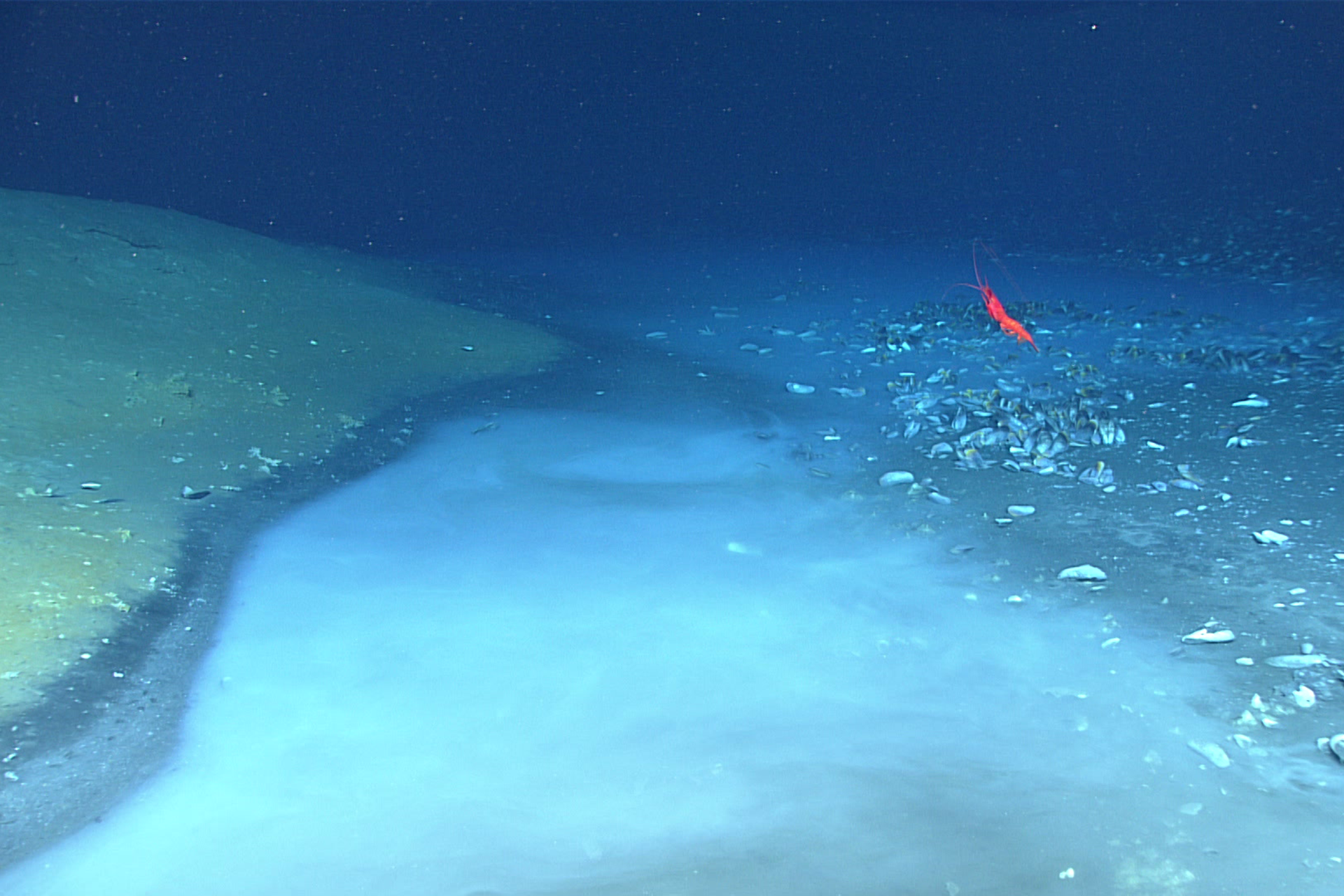
Photo credit: The NOAA Office of the NOAA Office of Ocean Exploration and Research
From Cartoon to Reality: The Mystery of Underwater Lakes
In the cartoon SpongeBob SquarePants, characters surf, sunbathe, and hang out at Goo Lagoon – a beach where the “goo” looks and acts like a separate body of water inside the ocean [1]. But wait – If they are all sea creatures which already live underwater, then why is there another pool? Isn’t the whole ocean already water? This seems like pure cartoon nonsense…until you learn that “seas within the sea” actually exist on the ocean floor!
These strange underwater lakes are called deep-sea brine pools. They’re not made of cartoon goo, but of extremely salty water. Because of this density difference, the brine doesn’t mix with the ocean above [2–4]. Instead, it sits on the seafloor like a lake, with a visible surface you can even “float” a robot submarine on [5]. Just like in the cartoon, animals that wander too deep into the brine can die – because inside, there’s almost no oxygen, and the water often contains high levels of hydrogen sulfide and methane, causing immediate suffocation and toxic shock for animals that enter it [2, 5, 6].
How Were Brine Pools Discovered?
One of the brine pool systems most frequently studied – the NEOM Brine Pools – was discovered in a 2020 expedition in the Gulf of Aqaba, between Saudi Arabia and Egypt [4, 5]. Located 1,770 meters below the surface, this site includes one large pool about the size of two football fields, and three tiny ones nearby [5].
The discovery of brine pools was made using a remotely operated vehicle (ROV) – basically an underwater robot with cameras. What they saw looked like something from another planet: a still, dark “lake” with an orange-to-gray rim, surrounded by shrimp and eels cautiously dipping in to grab stunned prey [4, 5].
How Do They Form?
Brine pools aren’t filled by salt dumped from the sky. Instead, they form when ancient salt layers, buried under the seafloor for millions of years, dissolve into seawater that seeps down through cracks in the ocean crust [5, 6]. These massive salt deposits are leftovers from a time when the water body was partially cut off from the ocean and dried up [4]. In some regions, geothermal heating can enhance this circulation and dissolution process.
The resulting brine is so heavy that it flows downhill like syrup and collects in seafloor depressions. In the NEOM pools, the salinity within just 15 centimeters below the brine surface is four times greater than that of normal seawater above [5]. The oxygen levels crash to nearly zero within just 50 centimeters down the surface, killing most sea creatures inside [5].
A Pool of Death or An Underwater Oasis?
While the center of a brine pool may seem deadly, its edges are surprisingly alive. Researchers found a novel species of clam, Apachecorbula muriatica, in this mixing zone between normal seawater and brine [5, 7]. Shrimp, eels, and sharks also patrol the edges, using the brine like a trap: They watch as small animals drift in, get shocked and sink, then dart in to scavenge the easy meal [2, 4, 5]. This is what the BBC calls a “brine pool of death” – not because it’s evil, but because its edges support life by harvesting death from its center [2].
Even more amazingly, life can also be found within the pool. The microbial communities vary significantly across different depths [5]. In the top layers, including the rim of the pool where microbes forming colorful “beaches,” the microbes are primarily aerobic. However, in the deeper regions, anaerobic microbes that can survive without oxygen take over. Those microbes are equipped with diverse metabolic capabilities to generate energy in low-oxygen environments, such as sulfate reduction, methanogenesis and fermentation.
Why Do Scientists Care?
Brine pools aren’t just weird – they’re scientific treasure chests. Because of its inhospitability to animals, the seafloor remains undisturbed due to the lack of burrowing animals. The sediments at the bottom stay perfectly layered, like pages in a history book. In the NEOM pools, scientists pulled up a 1,200-year-old sediment core that records flash floods, underwater landslides, and even tsunamis – including the one possibly linked to the powerful 1995 Nuweiba earthquake [4, 5].
So next time you watch SpongeBob surf at Goo Lagoon, remember: The ocean is full of real wonders stranger than fiction. The “sea within the sea” isn’t just a cartoon joke – it’s a window into Earth’s hidden past and possibly life beyond our planet.
References
[1] Goo Lagoon. (n.d.). Spongebob Fandom. https://spongebob.fandom.com/wiki/Goo_Lagoon
[2] BBC. (2017, November 3). Brine Pools of Death [Video]. https://www.bbc.co.uk/programmes/p05ll3c0
[3] National Oceanic and Atmospheric Administration. (n.d.). Brine Pools. NOAA Ocean Exploration. https://oceanexplorer.noaa.gov/multimedia/daily-image-media-20200917/
[4] Pappas, S. (2022, October 1). Rare Red Sea Brine Pool Holds Secrets of Past Natural Events. Scientific American. https://www.scientificamerican.com/article/rare-red-sea-brine-pool-holds-secrets-of-past-natural-disasters/
[5] Purkis, S. J., Shernisky, H., Swart, P. K., Sharifi, A., Oehlert, A., Marchese, F., Benzoni, F., Chimienti, G., Duchâtellier, G., Klaus, J., Eberli, G. P., Peterson, L., Craig, A., Rodrigue, M., Titschack, J., Kolodziej, G., & Abdulla, A. (2022). Discovery of the deep-sea NEOM Brine Pools in the Gulf of Aqaba, Red Sea. Communications Earth & Environment, 3, 146. https://doi.org/10.1038/s43247-022-00482-x
[6] Eder, W., Jahnke, L. L., Schmidt, M., & Huber, R. (2001). Microbial Diversity of the Brine-Seawater Interface of the Kebrit Deep, Red Sea, Studied via 16S rRNA Gene Sequences and Cultivation Methods. Applied and Environmental Microbiology, 67(7), 3077–3085. https://doi.org/10.1128/AEM.67.7.3077-3085.2001
[7] Oliver, P. G., Vestheim, H., Antunes, A., & Kaartvedt, S. (2014). Systematics, functional morphology and distribution of a bivalve (Apachecorbula muriatica gen. et sp. nov.) from the rim of the ‘Valdivia Deep’ brine pool in the Red Sea. Journal of the Marine Biological Association of the United Kingdom, 95(3), 523–535. https://doi.org/10.1017/S0025315414001234